

Inventory questions are the most common questions in a packhouse
Every hour, somebody in a fresh produce business asks about stock. Sales wants to know what is available to sell today. The warehouse wants to know which pallets to move first. Purchasing wants to know whether to bring in more product. Growers want to know how much of their consigned fruit is still in store. Management wants to know the value of inventory on hand. Each of these questions has a slightly different shape, and fixed stock reports rarely answer them exactly.
Pak-Bot answers inventory questions directly from live Producepak data. You ask in plain language and Pak-Bot returns totals, lists, breakdowns or charts, filtered to the sites and data your role allows you to see.
Examples of inventory questions Pak-Bot answers
- Total yellow potato in stock
- Weight of totes in stock
- Totals of inventory owned by ACE Farming Group
- Total of inventory at site Closters
- Red onion in poly bags
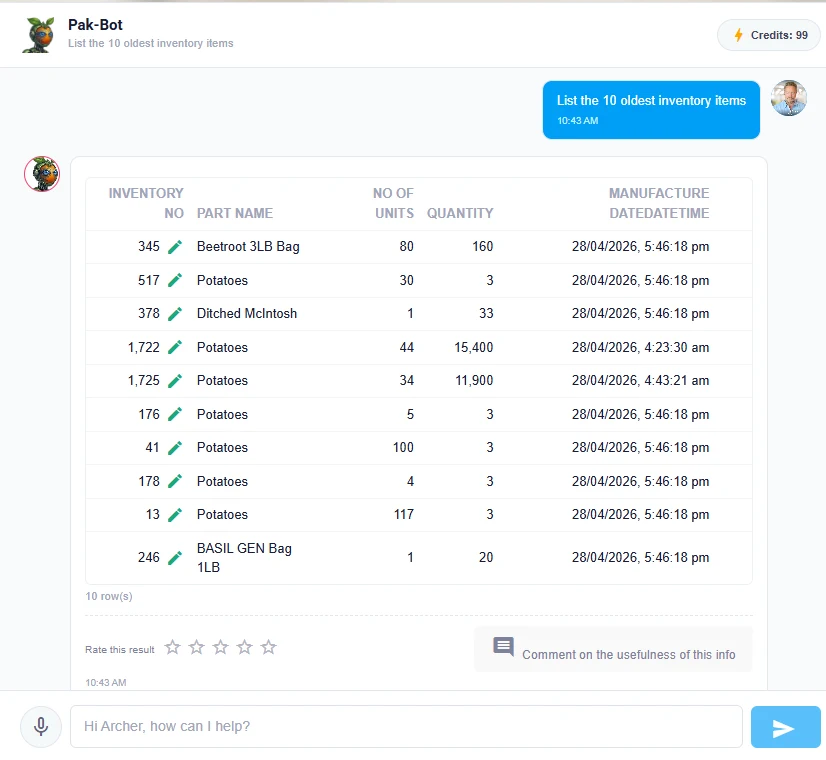
- List the 10 oldest inventory items
Each of these comes from the Pak-Bot examples supplied with Producepak. Together they show the range of inventory questions Pak-Bot handles: by product, by packaging, by owner, by site and by age.
Stock by product
The simplest inventory question is "how much do we have?" Total yellow potato in stock returns the total quantity of yellow potato across all the sites you can see. Pak-Bot understands that "yellow potato" may cover several Producepak products, such as different sizes, grades or pack formats, and totals them unless you ask for a breakdown.
To break it down, add the dimension you care about: "yellow potato in stock by size", "by grade", "by site" or "by pack type". To narrow it down, add a filter: "yellow potato in stock at site Closters".
Why product-level answers matter
Sales teams quote availability to customers many times a day. An inaccurate quote means either a short-shipment, which damages the customer relationship, or an under-quote, which leaves product unsold until it loses value. A direct question to Pak-Bot gives the sales team a current number without interrupting the warehouse.
Stock by packaging type
Fresh produce is stored and sold in many formats: field bins, totes, cartons, flats, clamshells, punnets, net bags and poly bags. The same product can exist in several formats at once, at different stages of packing. Pak-Bot can answer by packaging.
Weight of totes in stock returns the total weight held in totes, which is useful for planning packing runs and cool room space. Red onion in poly bags returns finished red onion stock in poly bag format, which is what sales can ship today.
Raw versus finished stock
Many packhouses hold the same product as raw intake (in bins or totes) and finished goods (in retail packs). Asking about the packaging is a quick way to separate the two. Ask for "potatoes in bins" to see raw stock waiting to be packed, and "potatoes in 2 kg bags" to see packed stock ready to ship.
Stock by owner: consignment and grower inventory
Many fresh produce businesses hold inventory that belongs to someone else. Marketers and agents sell on behalf of growers. Packhouses pack for multiple grower groups. Cool stores hold product for several customers. Producepak tracks inventory ownership, and Pak-Bot can answer by owner.
Totals of inventory owned by ACE Farming Group returns the stock currently held that belongs to that grower group. This answers one of the most frequent grower questions: "How much of my product is still in your shed?" It also supports grower settlement, because the stock owned by a grower, combined with what has been sold, drives the grower payment.
Faster grower communication
Growers expect timely information about their product. With Pak-Bot, a grower liaison can answer a grower's phone call with live numbers, then email the result: Email inventory owned by ACE Farming Group to the grower contact. Producepak's grower payment features handle the settlement itself; Pak-Bot gives fast visibility in between.
Stock by site
Multi-site businesses often struggle to see stock across locations. Each site has its own cool rooms, its own staff and often its own spreadsheet. Producepak holds all sites in one system, and Pak-Bot can total or break down by site.
Total of inventory at site Closters returns everything held at that site. "Inventory by site" returns a breakdown across all sites you have access to. "Potatoes at each site" combines product and site.
Site filtering is automatic
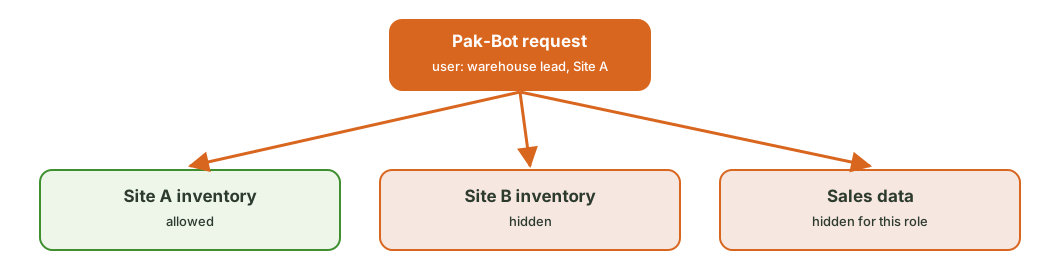
Pak-Bot knows which employees work at which site. A supervisor assigned to one site sees that site's inventory when asking general questions, without having to add a site filter. A manager with access to all sites sees the whole picture. See the security page for how this works.
Stock by age: first in, first out
Age is the most important inventory dimension in fresh produce. A carton of leafy greens loses value every day. Producepak supports first-in, first-out (FIFO) inventory management and expiry tracking, and Pak-Bot makes stock age visible on request.
List the 10 oldest inventory items returns the ten oldest items in stock with their inventory number, product, number of units, quantity and manufacture date and time. The warehouse can move these first, sales can offer them first, and management can see whether product is ageing in store.
Useful age-related questions
- Inventory older than 5 days
- Oldest leafy greens in stock
- Stock expiring this week
- Average age of potato stock by site
Reducing waste
Waste in fresh produce often starts with product that nobody noticed was getting old. A daily Pak-Bot question about the oldest stock, asked by the person who plans dispatch, is a simple habit that brings ageing product to attention while it can still be sold at a good price. Producepak's broader inventory features support FIFO allocation, stock takes and expiry management; Pak-Bot makes the information quick to reach.
Inventory value and weight
Inventory questions are not only about units. Depending on the product and the decision, the right measure might be weight in kilograms, number of cartons, number of pallets or value. Pak-Bot answers in the measure you ask for: "weight of totes in stock", "number of pallets of avocados", "value of inventory at site Closters".
Weight matters for cool room capacity planning and transport. Unit counts matter for picking and order fulfilment. Value matters for finance and insurance. Being able to switch between them with a word in the prompt saves the conversion work that usually happens in spreadsheets.
Charts for inventory
Some inventory questions are clearer as pictures. Ask Pak-Bot to chart them:
- Chart inventory by product group
- Chart inventory weight by site
- Chart stock owned by each grower group
A pie chart of inventory by owner shows at a glance which growers dominate stock in the shed. A bar chart by site shows where space is filling up. Each chart comes with a table of exact values.
From answer to action
Pak-Bot answers can be emailed or printed directly. A supervisor can print the list of the ten oldest items and hand it to the forklift driver. A sales manager can email current availability to a customer. A grower liaison can email a grower's stock position. Read more on the labels, email and print page.
How Pak-Bot inventory answers stay accurate
Pak-Bot's inventory answers are only as accurate as the inventory records in Producepak. Producepak is designed for accuracy at each step: receival scanning, pallet and tote tracking, packing records, picking by scan, and stock takes. When those steps are followed, every movement updates inventory, and Pak-Bot reads the current position.
Tips for reliable inventory answers
- Scan inventory at receival, packing, transfer and dispatch so that Producepak always reflects physical stock.
- Run regular stock takes and correct discrepancies in Producepak, not in a side spreadsheet.
- Use consistent product, packaging and site names so Pak-Bot can match your questions to records.
- Rate Pak-Bot answers and comment when a name or measure was misunderstood.
Who benefits from AI inventory answers
Warehouse and cool room teams
Find the oldest stock, check totals by site and packaging, and print lists for the floor, without waiting for an office report.
Sales teams
Quote availability with live figures, check stock of a product in a specific pack format, and offer older stock first.
Grower relations
Answer grower questions about their inventory immediately, and email them the numbers.
Management and finance
See inventory weight and value by site or product group, and spot product ageing before it becomes waste.
A day of inventory questions in a packhouse
To see how Pak-Bot fits into daily work, follow the inventory questions a typical vegetable packhouse might ask in one day.
| Time | Who | Prompt | Why |
|---|---|---|---|
| 05:30 | Dispatch lead | Red onion in poly bags | Confirm finished stock before loading the first trucks |
| 06:15 | Packing manager | Weight of totes in stock | Plan today's packing runs from raw stock |
| 08:00 | Sales | Total yellow potato in stock | Quote availability to a customer on the phone |
| 10:30 | Cool room supervisor | List the 10 oldest inventory items | Move ageing stock to the front for picking |
| 13:00 | Grower liaison | Totals of inventory owned by ACE Farming Group | Answer a grower's question about their product |
| 15:30 | Operations manager | Total of inventory at site Closters | Decide whether to transfer stock between sites |
| 17:00 | General manager | Chart inventory weight by site | End-of-day overview |
None of these people had to run a report, wait for an export or walk the cool room. Each answer took seconds and came from the same live data.
Inventory terms Pak-Bot understands
Pak-Bot reads your Producepak setup, so it understands the products, packaging types, sites and owners you have defined. Common fresh produce inventory terms include:
- Packaging: bins, totes, cartons, trays, flats, clamshells, punnets, net bags, poly bags, pallets.
- Measures: units, cartons, kilograms, pallets, value.
- Age: oldest, newest, older than a number of days, manufacture or pack date, expiring.
- Location: site names, and where configured, rooms or bays.
- Ownership: grower group, supplier or customer that owns the stock.
If your team uses words that are not in Producepak, such as a nickname for a cool room, say so in the feedback comment so the team can train Pak-Bot on it.
Inventory, traceability and recalls
Inventory and traceability are closely linked. Every pallet and tote in Producepak carries its history: which grower or supplier it came from, when it was received, how it was packed and where it has moved. In a recall, the first question is "how much of the affected product do we still have, and where is it?" Pak-Bot can answer that quickly, for example "inventory from lot 4471 by site". Producepak's traceability and recall features then provide the formal records.
Inventory accuracy starts at receival
The most common source of inventory error is the first step: product received but not scanned, or scanned against the wrong grower or lot. When receival is recorded accurately in Producepak, every later Pak-Bot answer about stock, age, owner and site is accurate too. Treat receival scanning as the foundation of reliable AI inventory answers.
Inventory FAQ
Can Pak-Bot tell me stock at only one site?
Yes. Add the site name, for example "Total of inventory at site Closters". Users assigned to a single site automatically see only that site's inventory.
Does Pak-Bot know who owns the inventory?
Yes. Producepak tracks inventory ownership, so you can ask questions such as "Totals of inventory owned by ACE Farming Group".
Can Pak-Bot show stock by packaging type?
Yes. Ask about the packaging directly, for example "Weight of totes in stock" or "Red onion in poly bags".
Can Pak-Bot help with FIFO?
Yes. Ask for the oldest inventory items, or stock older than a number of days, to see which product should move first.
Related pages
See how Pak-Bot handles sales analytics, quality and yield and ad hoc reports and charts, or browse the prompt library for more inventory questions. To see Pak-Bot answering questions about stock that looks like yours, book a demo.